SEARCH EVENT
-
Artemisia Gentileschi talk with Maria
15 August – 31 October 2020 -
Artemisia Gentileschi talk with Maria
15 August – 31 October 2020 -
Artemisia Gentileschi talk with Maria
15 August – 31 October 2020
Collection

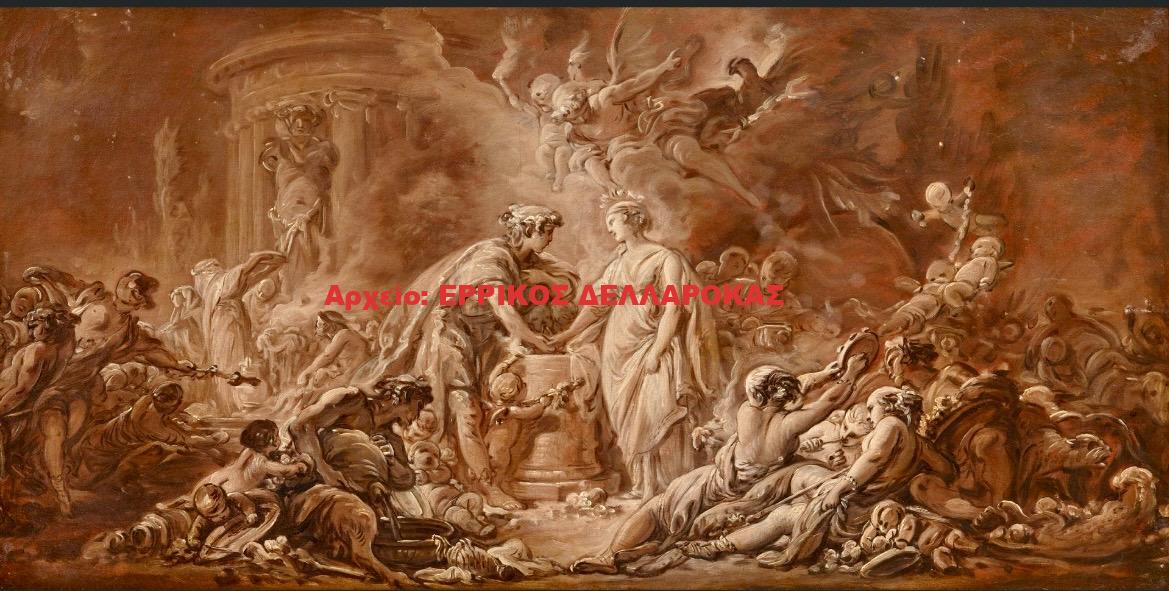
1743 ARIADNE and BACCHUS
FRANÇOIS BOUCHER
(1703 Paris 1770)
The marriage of Ariadne and Bacchus on the Island of Naxos (Grisaille).
Oil on canvas.
41 × 80.5 cm.
With an art-historical analysis by Dr Françoise Joulie (18 January 2026), to whom we are grateful.
This exceptional painting comes from a private collection in Switzerland, where it has been in the same family for several generations, and constitutes a major rediscovery for French painting.
It depicts a scene from Greek mythology with the wedding of Ariadne, daughter of King Minos, and Bacchus, the god of wine.
Ariadne, abandoned by Theseus in spite of her declarations of fidelity, subsequently fell in love with Bacchus.
Before an ancient temple and surrounded by a cheering crowd, the newlyweds appear as a youthful and idealised couple.
Numerous motifs typical of bacchanals enrich the depiction: a satyr pours wine into a large chalice, another holds a Thyrsus rod on the left, maenads accompany the celebration with music, putti hover over the scene, and the two leopards that traditionally pull Bacchus’ chariot can be made out in the right half of the picture.
François Boucher was one of the most versatile artists of the 18th century and was active as a painter, engraver, draughtsman and decorator. His virtuosity is very much in evidence in the present work. As with many of his designs, the monochrome execution in grisaille shows that Boucher first devised the composition and lighting before introducing colour. Characteristic elements of his style, such as the foreshortening, bold accentuation and simplified volumes, are clearly recognisable here. The dynamic composition of this picture points to the artist’s mature creative phase around 1750.
During this period, Boucher was closely associated with the Parisian manufactory of Beauvais, which was under the protection of the king, and for which he created numerous carpet designs. Around 1747, he was commissioned to design a cycle on the loves of the gods based on
‘Ovid’s Metamorphoses’ and the ‘Ars Amatoria. One of the proposed themes was the marriage of Bacchus and Ariadne, although in the end a slightly modified design focusing on Bacchus’ triumphal procession was carried out.